Hopes and Dreams

I’ve been anxiously anticipating the release of “Jurassic Park IV” for about…14 years now. The film was first announced in 2001, right after the release of Jurassic Park III. Originally Steven Spielberg said he would return as director because Joe Johnston had so severely bollocks’d up the third one. Naturally that was music to my ears, but hope faded as the years went on. I turned thirteen, then fourteen, and then fifteen. Eventually I graduated high school, served a year in the military, and travelled to the other side of the world to begin my university studies. I graduated from uni, travelled back to Norway, worked for a year, then returned to Australia for another batch of education. Here I sit today, twenty-six years old, halfway through my second bachelor, and it would appear that after all this time…life found a way.
The fourth episode of the Jurassic Park franchise has just hatched at the box office. There are, however, some unpredictable changes that have occurred during its development. Spielberg has taken a backseat producing role and the film’s no longer called Jurassic Park IV; it’s called Jurassic World.
I, for one, love the title! It’s perhaps not perfect but, considering the legacy, it’s a great choice.
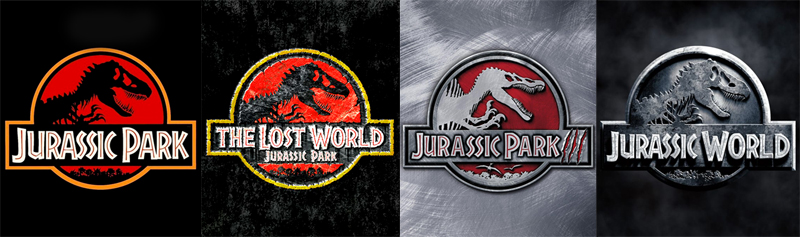
We have Jurassic Park, followed by The Lost World, leading into Jurassic Park III, and now a great hybrid creation; Jurassic World. It even bares some poster-design similarities to JP3, so every previous venture has been acknowledged.
I’m working over the next two weekends and as a result will probably not get to see Jurassic World for quite some time. The reactions so far have been mixed but largely encouraging, so I’m looking forward to it with all the excitement you would expect. In fact, I’ve done something unusual in preparation for it; I’ve avoided absolutely all advertising and premise information about the film. I want to go into this movie knowing nothing, just like I did with the original, and as a result have averted my gaze from every trailer, screenshot, and plot synopsis that I could. At this point all I know about the film extends the width of the poster. I’m going in totally plot-blind.
Well, not really. I know Chris Pratt is in it. That fact couldn’t be avoided. I also know that it has something to do with genetic modification. Aside from that, though, I’m effectively Hans Schultz.

Most people who know me will know that the original Jurassic Park is my favourite film of all time. I love it so much that it was the first film I ever wrote about on this blog. I could spend weeks talking about the effect it had on me as a child. Like a Catholic Priest, it touched me in a very special place. At 7 years old, this was my first moment witnessing the awesome power of computer animation and masterful filmmaking. Nearly two decades later and I’ve chosen to follow two complimentary artistic career paths; Computer Animation and Filmmaking.
In a little over 14 days I’ll be sitting in a theatre with a big box of popcorn on my lap. The lights will go down, the screen will widen, and I’ll once again be back in that luscious jungle landscape. So what, you may ask, am I hoping Jurassic World will give me?
Well, I try to lower my expectations every time I see a film…but since you’re asking…
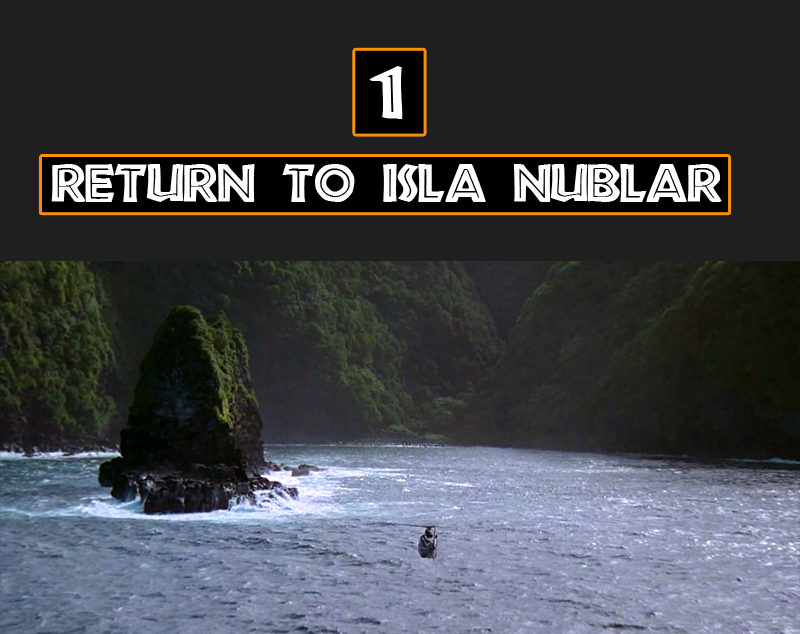
Let’s start with the small stuff. Many people won’t know this, but there are in fact two Jurassic Park islands. They’re part of an island chain off the coast of Costa Rica; six islands, one far off in isolation and five strung close together. The latter five are known as Las Cinco Muertes, or “The Five Deaths”.
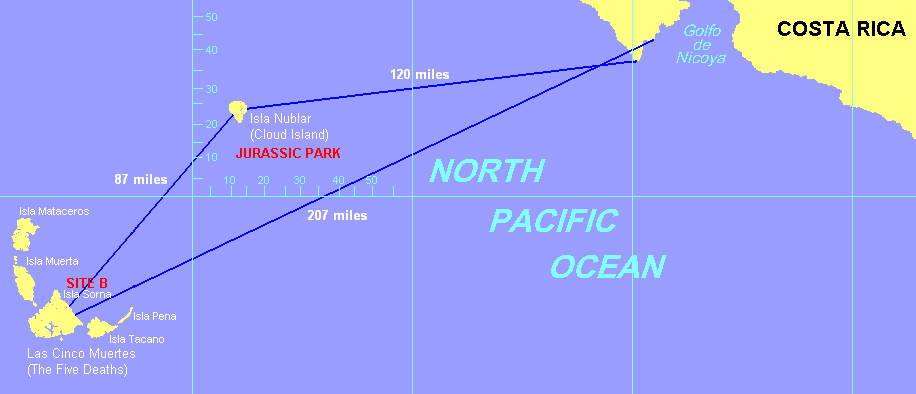
It’s on one of these Islands, Isla Sorna (known as Site B), that the dinosaurs were cloned and nurtured. They were then moved to Isla Nublar and placed in the Dino-Zoo we see in the original film. Both The Lost World and Jurassic Park III took place on Isla Sorna. Why? I have no idea. Personally I’d like to see a return to Isla Nublar. It would be a chance to step back into the original architecture from the first film. The Jeeps, the Tyrannosaur paddock, the kitchen where the Raptors stalked the children, I want to see some of that again. However, it’s a minor nostalgic request that I can certainly live without.
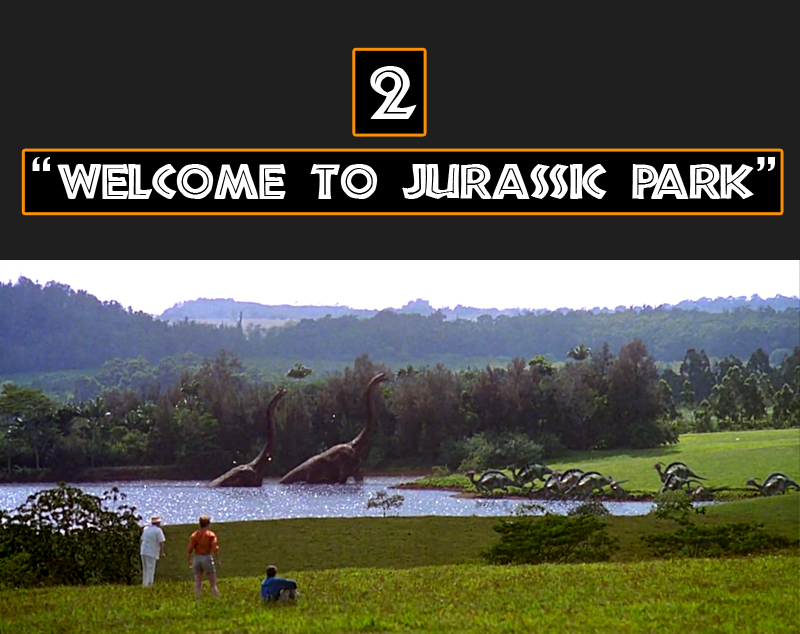
This one might seem pointless and pedantic, but it’s actually a big deal. John Hammond saying “Welcome to Jurassic Park” is one of the best moments in the first film. It bathes the audience in a revealing moment of awe, that gives us a glimpse of the unending possibilities before us. The best part is that we know we’re only at the beginning of our journey, and already enjoying such bliss.
Now, if this line does appear in the fourth film, it will obviously be changed to “Welcome to Jurassic World“. That’s fine, but the correct emphasis needs to still be there.
While we’re at it, it would be nice if someone also said “Clever Girl!” or “Spared No Expense!”, but I won’t be greedy.
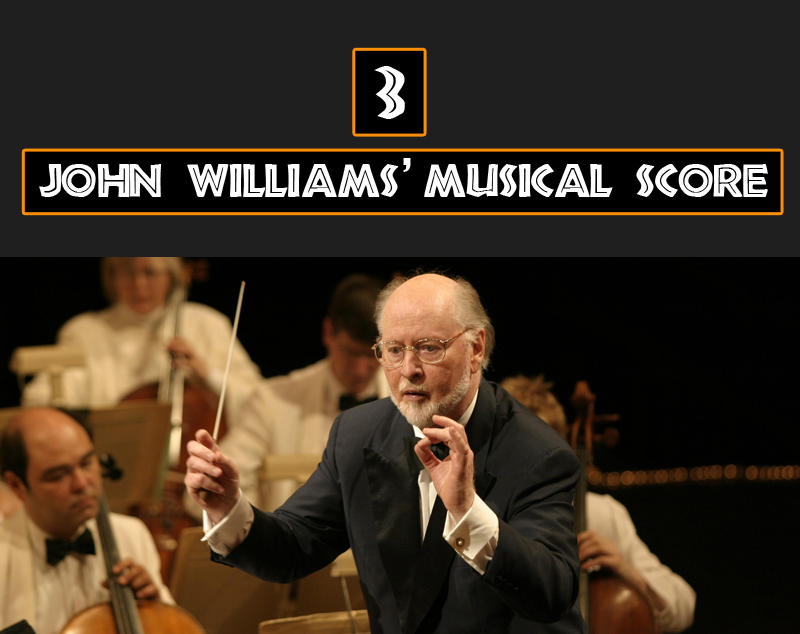
John Williams isn’t providing the score for Jurassic World. He left the franchise after The Lost World, just like Steven Spielberg. However, his musical score is iconic, and needs to be honoured. I’m not just talking about the main themes. Remember the opening titles, with those slow thudding buildups, foreshadowing female voices, and that final creepy flute? That’s the kind of thing I want from the very first moment.

How great would it be to see Mr. DNA again? Come on, you know you loved this guy. Of course, Mr. DNA was always just a narrative device that explained the science of dinosaur cloning to us without Hammond having to utter even more exposition than he already was. It doesn’t matter to me though, this guy gave us an insight into the family-friendly intentions of the park. He’s an obvious homage just waiting to be exploited.
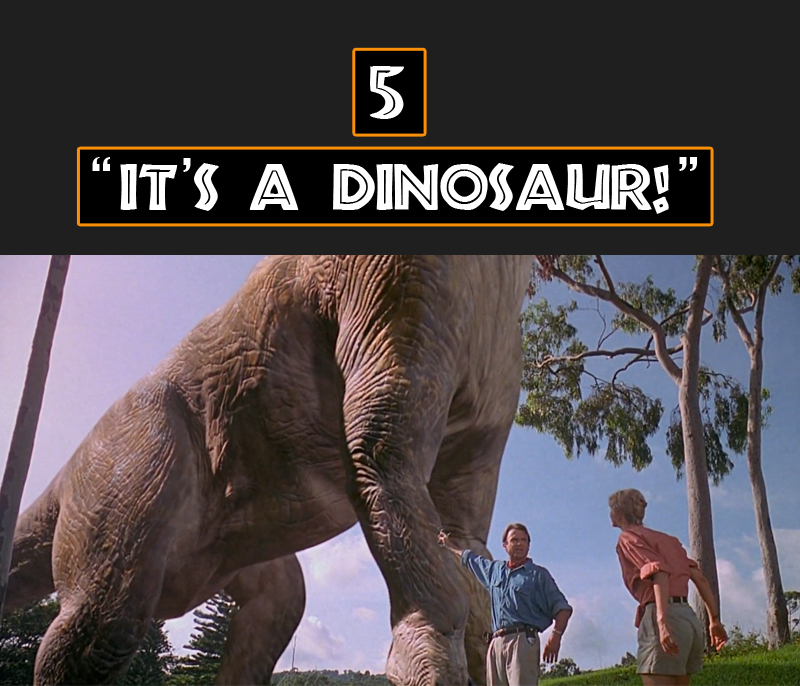
Don’t worry, I don’t need someone to say “It’s a Dinosaur”. What I need is for the filmmakers to remind themselves of this fact.
One of the things that made Jurassic Park unique among dinosaur films was its attitude to the creatures themselves. Spielberg made it very clear from the first day of pre-production that he wanted to treat them like animals.

He was adamant about not turning the dinosaurs into monsters. Sure, once everything goes south “there’s running and screaming”. Still, the Raptors and the Rex are depicted as believable carnivores. Stan Winston recalls several times when Spielberg would re-think the specifics of the dinosaur effects just to allow for subtleties like an expanding ribcage, so you could see the dinosaur breathing. Palaeontologist Jack Horner was front and centre as the dinosaur consultant, making sure that everything was accurate. That is, of course, with the exception of this:
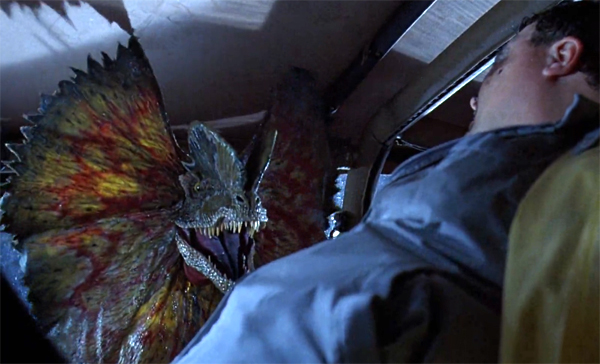
The Dilophosaur never had a frilled neck, nor venom to spit at anyone. This creative licence was used to make a plot point during the demise of Dennis Nedry. While we’re at it, it was also significantly larger and Velociraptors were actually the size of a small dog. Whatever!
The point is that I don’t want Jurassic World to forget that it’s depicting animals. If I get too much of a monster-movie feeling I’m going to be disappointed.
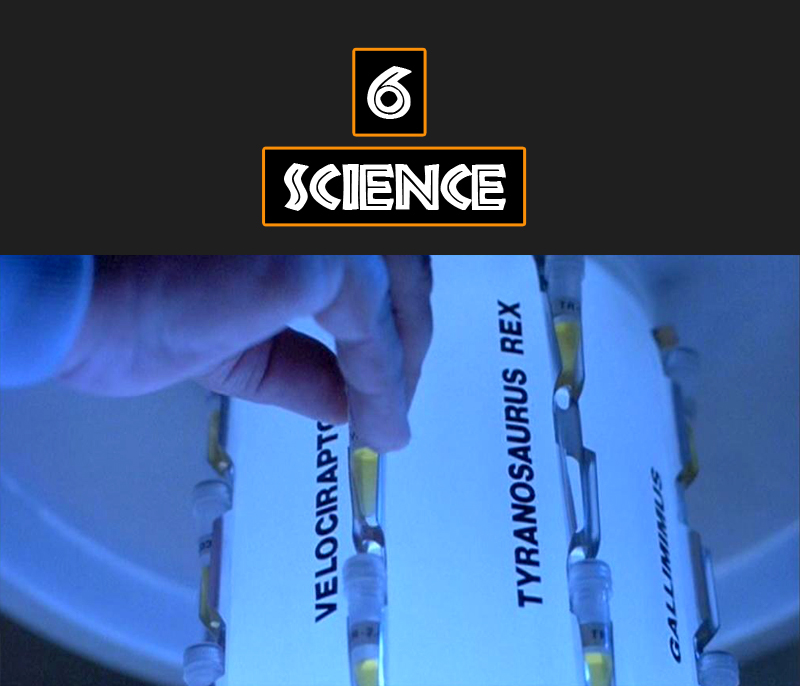
It’s important to remember that technically Jurassic Park was always science fiction. The book is almost entirely concerned with science and scientific/philosophical discussions. The film does a masterful job or retaining as much of that idea-clashing in its script as possible before giving way to spectacle. Of course I’m typing this directly under a still from the movie that shows “Tyrannosaurus” spelled incorrectly. Brilliant!
Here’s a telepathic pop quiz for you. Which Jurassic Park scene do you think is my favourite? Is it the T-Rex breaking out of her enclosure? No. Is it the Raptors hunting the children in the kitchen? Nope! Is it the first time we see the Brachiosaur? Nuh-uh! It’s this one:
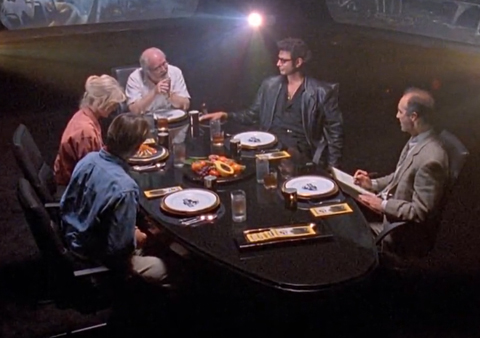
From a narrative point of view this is the most crucial scene in the whole film. It’s where everyone lays their cards on the table and billboards their perspectives; Belief, disbelief, ignorance, concern, and agnosticism. Beyond that, there’s wonderful rich dialogue going on with scientific and philosophical approaches brushing up against each other in fury. It’s a lovely thing to watch.
If you devise a premise where dinosaurs are being brought back to life for entertainment purposes, then you owe it to your own story to explore the implications of such an event.
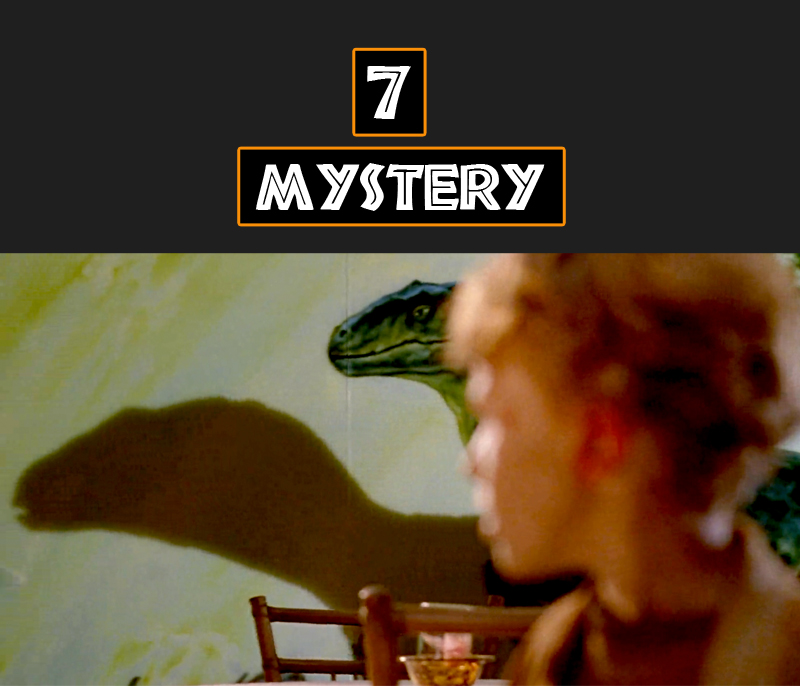
One of the reasons I’ve tried to avoid everything about Jurassic World is because I don’t trust movie trailers these days. Studios have decided that they will always prefer money over critical acclaim, and therefore have adopted the “bums in seats” marketing strategy. They throw everything juicy into the trailer in order to make people think “that looks good.”. Then when you watch the actual film, there’s nothing left to enjoy. The only bits that were kept in the dark were essentially just filler anyway.
Here’s the original trailer for Jurassic Park:
Notice something? It gave you the premise and even a fair bit of plot development, but you basically saw nothing of the dinosaurs. Every shot of a dinosaur was either obscured, incomplete, went by too fast, or was implied. This is what’s known as…wait for it…”good marketing”!
That’s right, it was better to just give us a hint of the “monster”. If you wanted to actually see it then you had to buy a ticket. That was brilliant, and I have no doubt that the Jurassic World marketing campaign falls far short of it.
As for the film itself, only 15 minutes of the 2 hour long Jurassic Park actually contained dinosaurs. That leaves 1 hour and 45 minutes devoted to people talking, walking, and pushing the plot along on their own. It’s 1 hour and 3 minutes before the main dinosaur, the T-Rex, makes her appearance and only after 1 hour and 44 minutes do we get our first look at the much-discussed Velociraptors (That’s just 16 minutes before the end of the film!). I can only hope that Jurassic World takes some inspiration from this and doesn’t completely saturate us with the animals themselves.
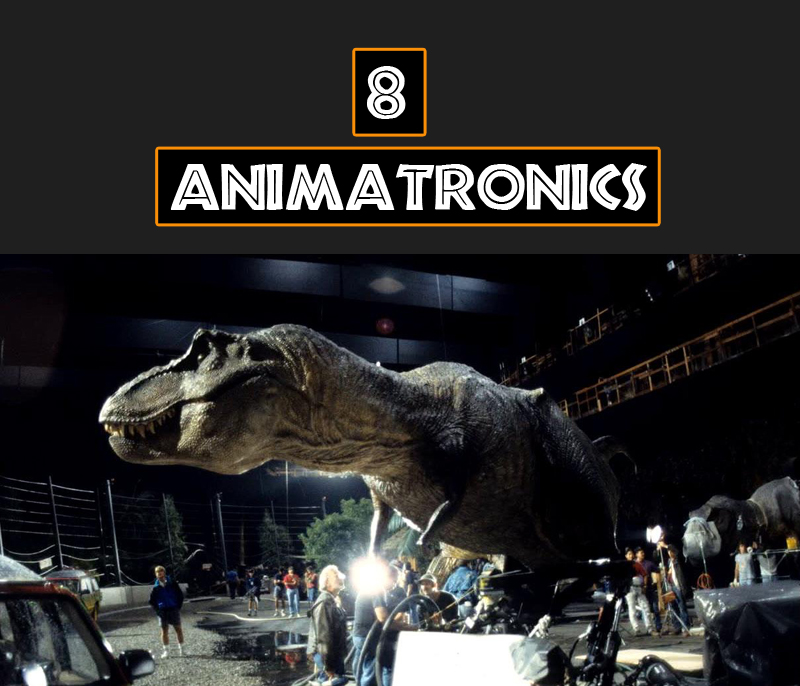
I don’t have high hopes for this one, but I really want to see the continued use of animatronics in the JP franchise. Nowadays creatures are rendered entirely in CG, both in wide shots and closeups. That’s fine, but since all the previous films in this franchise have used animatronics, it essentially becomes a continuity issue.
How bizarre to be sitting here asking for less CGI in a sequel to a movie that was so highly regarded for its pioneering contributions to that very industry. Weird!
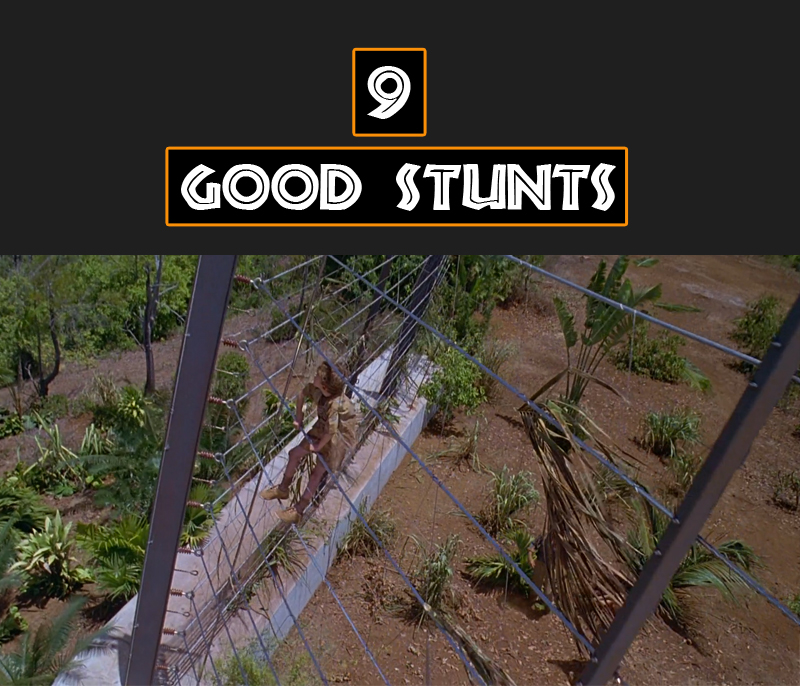
Stunts have always been a big part of Jurassic Park. In the original we have a car pushed off a cliff with Tim inside it, the car then chasing Tim and Alan down a tree, Tim being electrocuted on a fence, and then a dinosaur skeleton falling on top of…Tim. Jesus Christ! Tim really was tortured a lot in the first one! What, did Spielberg just hate the little tyke?
In The Lost World we have that long, but very well paced, “trailer-hanging-off-the-cliff” sequence. In fact, we have a stunt within a stunt, when the people inside struggle to prevent each other from falling out the other end.
Jurassic Park III starts off with a parasailing boat-collision, then throws the main characters into a plane crash, and eventually ends up with someone skydiving amongst Pterodactyls. The skydiving was too much for me. I hope they don’t go that crazy in Jurassic World, but there needs to be some decent stunts. Preferably they give us some that aren’t just spectacular but also provide a lot of excruciating tension.

Let’s not forget that the first (and to some degree the second) Jurassic Park had a great deal of horror sequences. The scene with the T-Rex is an obvious example, but it’s easily matched and possibly even outdone by the sight of a Raptor chase Ellie down a dark underground hallway. With jump scares, dingy lighting, and eerie music, there are entire sections of the series that are downright terrifying. Jurassic World, please don’t beckon me into the cinema just to give me colourful flashy fun. I want to be a little frightened as well.
I know I’m not going to get all of my requests. In fact it’s extremely unlikely that I’ll even get most of them. The film is out now, so all I can do is cross my chromosomes and hope for the best. Obviously it goes without saying that I’m hoping, above all, for a good story with interesting characters and a plot that keeps me hooked. Getting my little wish list would be the cherry on the icing on the cake.
Regardless, it’s a wonderful day when a new Jurassic Park film is sitting in the cinema waiting for me. How can I complain, really?
Jonathan’s Three
I’d like to separate the entire world’s population into five categories.
A. People who are unaware of my last blogpost.
B. People who glanced at my last blogpost but didn’t bother to read it.
C. People who read my last blogpost but can’t be bother to check out any of the movies listed there.
D. People who read my last blogpost and want to check out the movies listed there but haven’t gotten around to it yet.
E. My peeps, eeeeyyy!
Categories A, B, and C consist of well over 7.3 billion people, but they were never my crowd anyway. They’re the ones that are interested in all those other “important” things like politics, science, education, career, and family. Boring!
If you’re a D or E person, then you’ve made it to the next round. Congratulations! There’s no prize, boo hoo, so what? Admittance is its own reward, right? You, my lucky lucky star, get to do MORE READING! Yay! Confetti!
Nawww, look at you all excited. Alright, so what’s on the menu for today?
Well, it’s partly a recap, really. An expansion, if you will, on the final act of my last article. If you’ll recall, I ended it by recommending Under the Skin as the best film of 2014. If you’ve seen it by now, then hopefully you’ll know why I loved it so much, but may find yourself wondering what kind of deviant mind could conjure up such a thing. Well, that would be…
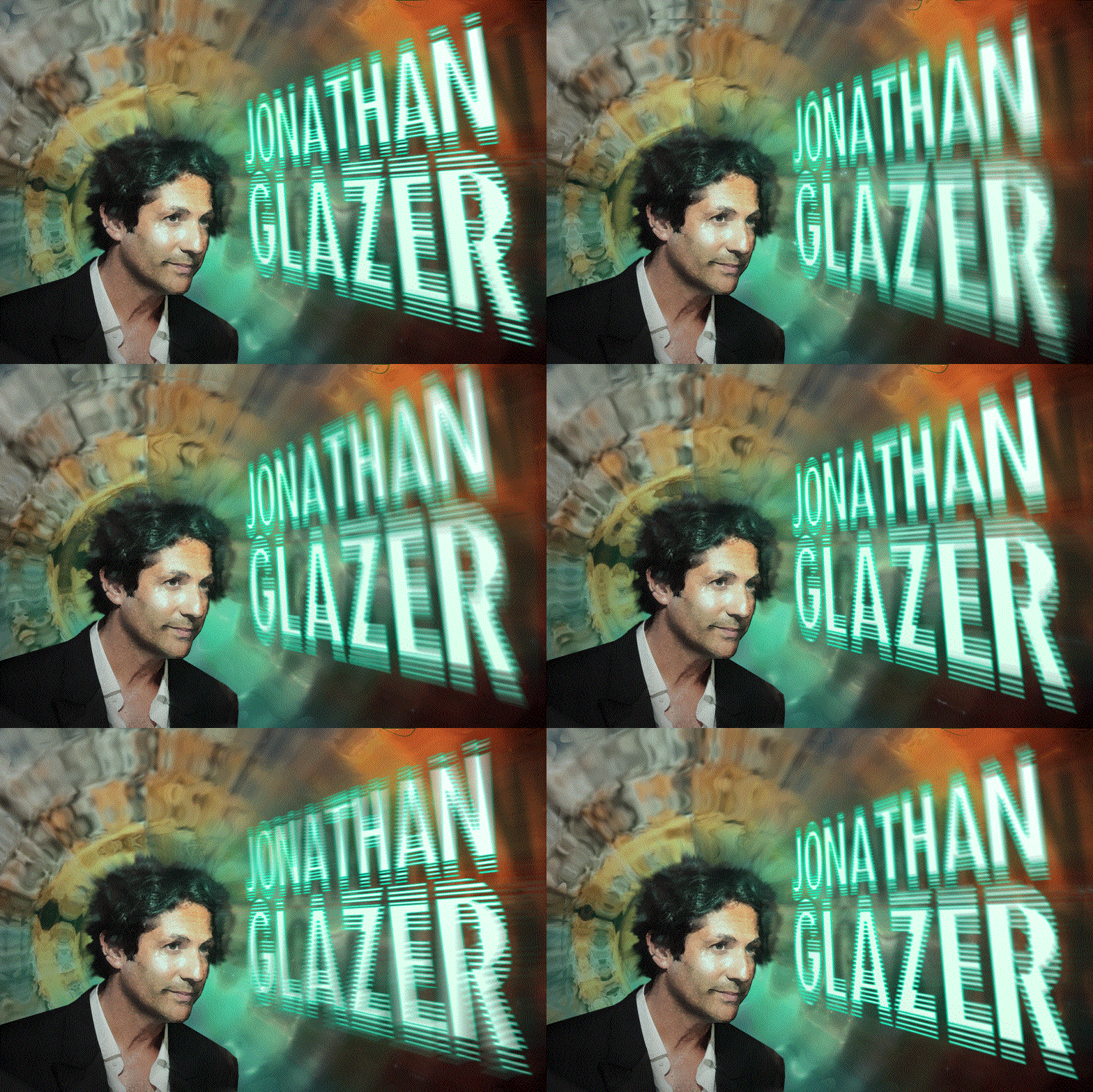
Jonathan Glazer is a filmmaker I was unaware for a long time, but holy shit I’m certainly a devout follower now. The most amazing thing about this man’s career is how sparse it is.
First off, the man is clearly insane. Except he’s not “Hitler” insane, he’s more “Van Gogh” or “Kubrick” insane. Calm, collected, and articulate as he may be, his imagination and originality is incomparable.
Glazer started off doing Music Videos and TV Adverts with a heightened sense of style and artistry to them. They can all be seen on Youtube, and are…unique. Many of you will recognise his Sony Bravia Ad, below. Bright, beautiful, colourful and fun, but never more than an arms length away from sheer madness.
Did you see the random insert shot of the running clown?
See? Madness! And yet so majestic. That’s why I love him. He’s my favourite kind of auteur; teetering on the precipice of pretentiousness but never forgetting to entertain you. So what happens when you take all that twisted talent and apply it to feature films? This:
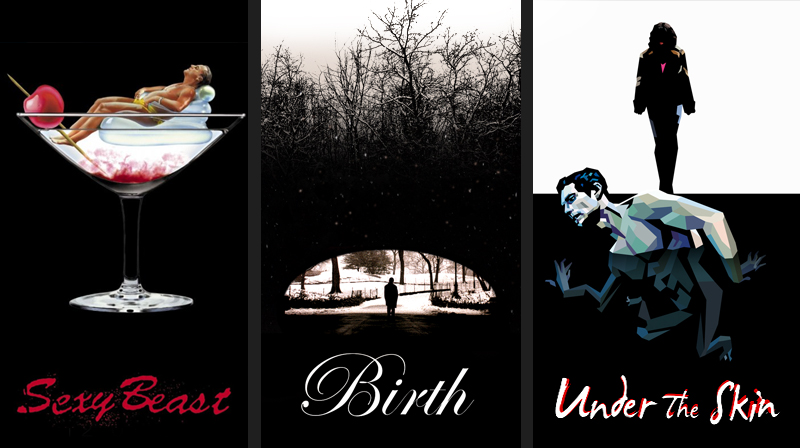
What you’re looking at is the Jonathan Glazer Trilogy! They’re the only three feature films that Glazer has ever made. Three wildly different plots within vastly disparate genres, there’s nothing else to link them besides the following; they’re all masterpieces!
Certainly!
While reflecting upon his work, I’ve tried to nail down what the most impressive thing about Glazer is. I think I’ve got it; he’s a master of tone.
The three films I’ve laid before you each have a very unusual but precise tone. Sexy Beast is half an art house film and half a geezer gangster romp. Birth is somewhat sweet, dramatic, mostly sad, and all kinds of creepy. Finally, Under the Skin plays with the uncanny void between all that is warmly human and that which is chillingly alien. I’ve never seen any other filmmaker blend the genre equivalents of oil and water so impressively well. I’m genuinely dumbfounded, because it shouldn’t be possible.
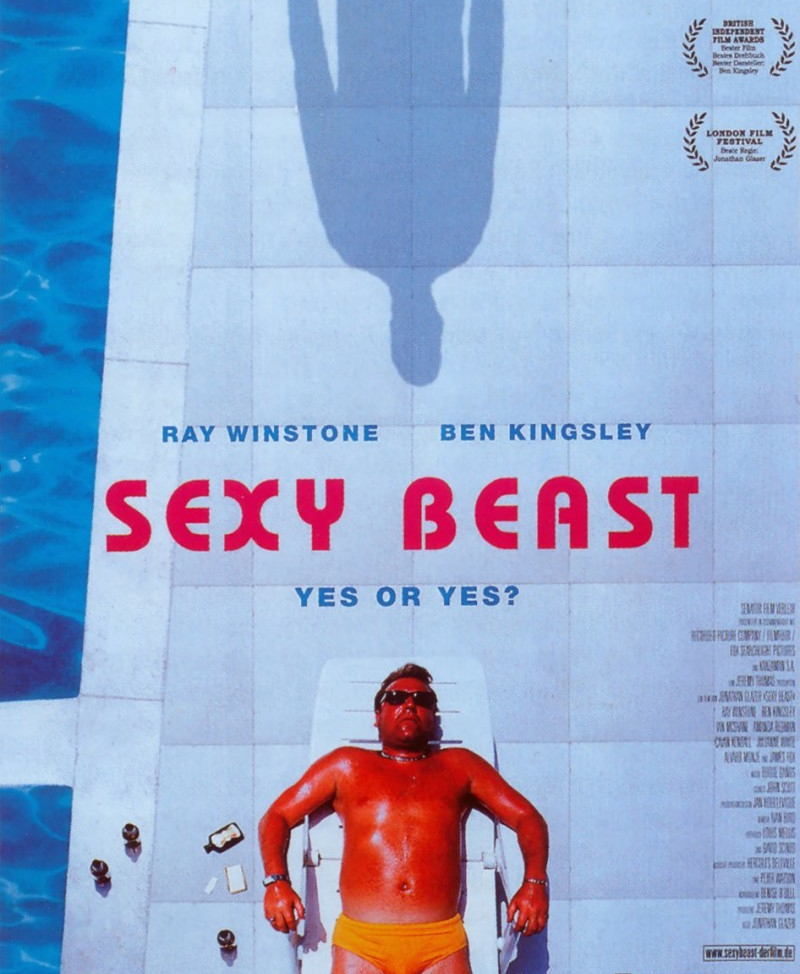
The best way to sell Jonathan Glazer’s directorial debut, Sexy Beast, is as a marriage of Donnie Darko and Guy Richie. I don’t have much love for british gangster films. I find that they lean heavily of cockney lingo, humourless profanity, and boring predictable violence. Sexy Beast puts all that on the back burner. It’s almost entirely set in Spain and features very few characters, worlds away from the typical Snatch ensemble meeting in darkly lit rooms and London alleyways. Best of all, there is a real artistic approach, and all notions of genre expectation are thrown to the wind.
“Ex-villain Gal Dove has served his time behind bars and is blissfully retired to a Spanish villa paradise with a wife he adores. The idyll is shattered by the arrival of his nemesis Don Logan, intent on persuading Gal to return to London for one last big job.”
-Synopsis
With an energetic cinematography that mirrors the style of Boogie Nights, Sexy Beast skips along and doesn’t waste a second. Straight to the point, we’re introduced to two actors playing very much against type. Ray Winstone, who is typically the very face of hardened “gangsterness”, plays Gary “Gal” Dove. Dove by name and dove by nature; he’s calm, considerate, and genial. Ben Kingsley on the other hand, who’s most famous role was Gandhi, plays an absolute roaring psychopath. Don Logan, gangster or not, displays the most unpleasant selections of traits ever assembled into one character. He shouts, swears, prods, rambles, and violently attacks people all in the pursuit of his goal; to bring Gal back into the crime scene. Most annoyingly, he’s stubborn and he loves to repeat himself.
Give Sexy Beast a go, but be prepared for a lot of “four letter words”. Also, ask yourself…why is it called Sexy Beast? There is an answer.
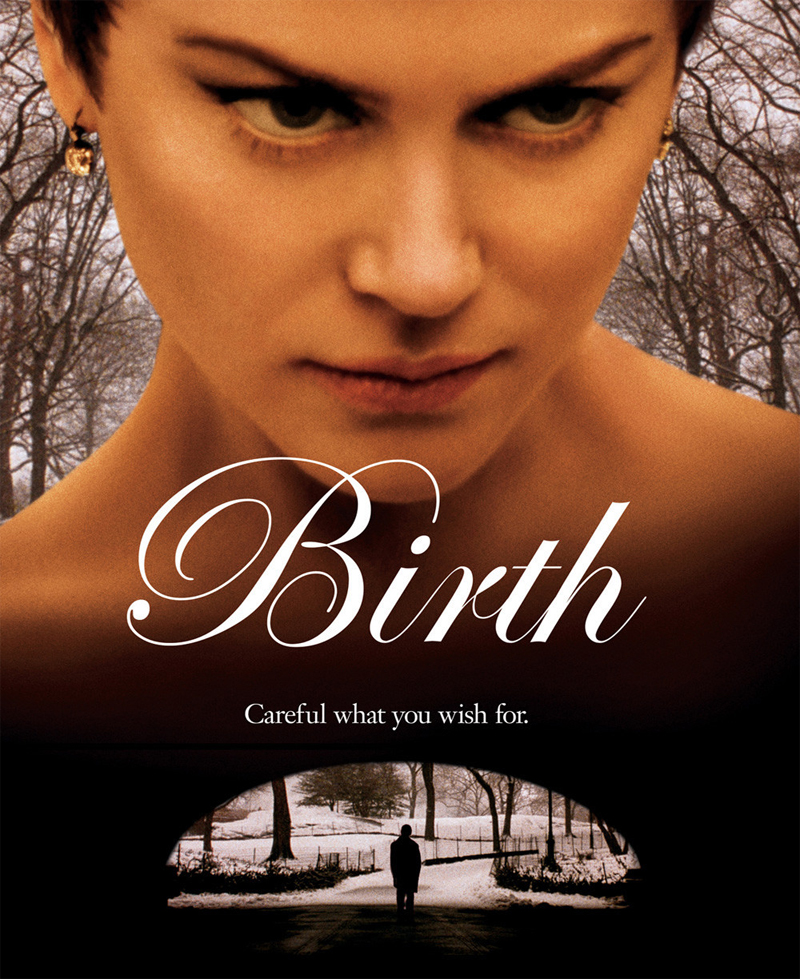
Remember Nicole Kidman before she became a wax statue? I do. In fact Birth may just be the last film she made while she was still completely human.
So, after Sexy Beast Glazer was no-doubt flooded with British-crime film scripts. A lesser artist (GUY RICHIE!) would have lazily repeated himself (GUY RITCHIE!) and never done anything else (GUY RITCHIE!) because they’d rather play it safe. Well, not this guy.
One day while working in his kitchen, Glazer had the vision of a little boy confronting a woman and telling her that he was her dead husband. After four years of development it became Birth.
“A young boy attempts to convince a woman that he is her dead husband reborn.”
– IMDB
Birth is probably the most accessible film on this list, so if you’re an unadventurous filmgoer then this might be the best place to start.
Unbelievably, Birth is even better than Sexy Beast. Since it’s totally different in every way it becomes hard to compare the two, but I know that I enjoyed Birth a lot more.
When the film premiered at Cannes, many critics booed and hissed at it. Several walked out of the screening in disgust. Why? Well, because on some level the film flirts with the concept of pedophilia. That’s not to say that the movie is in any way about pedophilia, but it certainly ventures into that dangerous area of discussion.
The central questions are; if a child came to you and claimed to be a deceased loved one, what would it take for you to believe them? If you did, would that even allow you to treat them the same, or love them the same? How could you recognise the person you loved and lost underneath all the superficial differences? How much of their fundamental characteristics need to remain intact for you to re-establish your personal connection with them? Finally, how well do you really know the person you love(d)? Might your own sense of loss be filling in the blanks for you because you need their return to be true?
It’s an interesting concept no matter which angle you come at it from, believing in supernatural occurrences like reincarnation or dismissing them with objective scepticism. I’m always a sceptic myself, but I loved the experience of not knowing where this film was going to land. Is he really her dead husband reborn? Could he just be a weird child? How could he know so much about his life? You’ll have to watch the film to find out.
One thing is certain, though. This kid is wickedly creepy:
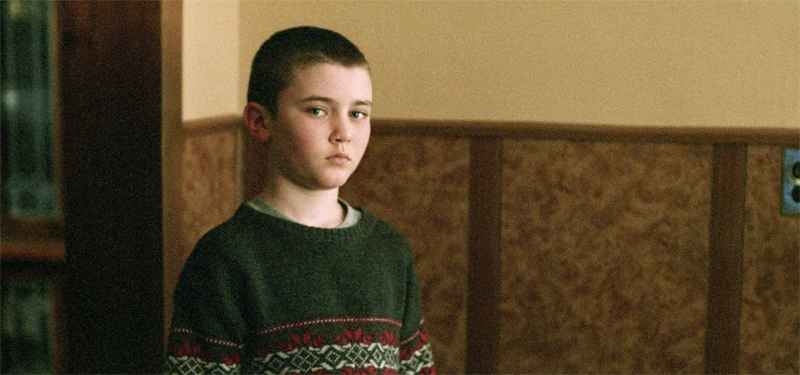
“It’s me, Sean!”. *shivers*
Well, maybe he’s creepy, or maybe he’s just desperate to reconnect with his wife. Again, it all depends on what you believe about his claim, and your allegiance is bound to flip flop throughout the picture. This is due, in large part, to Alexandre Desplat’s emotionally acute musical score.

From the moment the movie starts, you know you’re in good hands. Glazer gives us a 1 minute and 48 second uncut shot of Sean running through a snow-covered park. I’d normally call this editing decision a self-indulgent one, except that it gives us apt time to reflect on Desplat’s overture, which plays through all of its peaks and lulls in order to tell us exactly what tone we’re in for over the next 90 minutes. Beginning with the flighty sound of ethereal flutes flapping like pigeons in the upper ranges, it later slips into warm comforting violins and ultimately confronts us with bombastic skeletal drums. It’s a lovely melodic introduction that filmmakers and musicians alike can appreciate.
Upon analysis, Birth is above all about loss. Kidman’s performance in the movie highlights one thing; while she may project and inject the artifice of closure…she has, in fact, never recovered from losing the love of her life. Worse yet, she probably never will.

I loved Birth. Most filmmakers couldn’t do much better, and that would be perfectly acceptable. Glazer, against all odds, can’t help but outdo himself. Ten years after Birth, he made what is clearly the best film of this decade as well as the last one; Under The Skin.

Oh, shit…you saw it, huh? Alright, no, fuck it, if you didn’t like it then you’re just wrong! Let me forcibly educate you as to why, with a little crash course in film school:
Film was not always an art form. It was initially invented as a piece of scientific technology. It was not immediately recognised as a form of artistic expression, much less as a medium for storytelling. In its first incarnation, film was merely used to document reality and project it back to audiences for amazement. However, it gradually changed as artists were able to adapt it for other purposes, and probably made its greatest stride with the discovery of the “montage”.

We all think we know what the term “montage” refers to. Some may begin to hum the Montage song from Team America, while others remember the compressed training sequence from Rocky. That’s not, in full, what the word “montage” is referring to. “Montage”, in film terms, means the mere compositing of images to tell an overarching narrative. You may take it for granted, but your brain is actually doing a hell of a lot of work in order to understand the relationship between each shot in a movie. The fact that a movie can be intuitively understood says a lot about a human being’s ability to comprehend visual patterns. The question is, how much of the legwork can you let the audience do for themselves before the whole thing becomes confusing?
There are five types of montage; Metric, Rhythmic, Tonal, Overtonal, and Intellectual. I’ll let you look up the meaning of these on your own time, but they all hang upon the peg of what’s known as “The Kuleshov Effect”.
Lev Kuleshov was a Soviet filmmaker who experimented with the psychological effect of film on its audience. What he discovered was the hidden participatory element that the audience member brings to every editing decision a filmmaker makes. That might sound like mumbo jumbo to you, but it’s actually really fascinating when you understand it. Here’s how it works:
Kuleshov experimented by showing these three different sets of images to three different audience groups:

Three different mashups; a bowl of soup, a child in a coffin, and a beautiful woman, always followed by the same static shot of a man’s face.
Those who saw the “soup” version commented on how hungry the man looked, those who saw the child in the coffin remarked at his obvious sadness, and those who saw the beautiful woman were moved by how much the man appeared to be in love.
So what’s going on here? It turns out that this is the psychological phenomenon on which film editing is based. Firstly, as a viewer you are making the connection that the two shots are happening in the same local space and sequentially happening one after the other. It’s an assumption you will always make unless the filmmaker has made it clear, somehow, that they are separate incidents. Then, you deduce that since the man is staring slightly off camera then he must be looking at the following subject. Then, you contemplate the effect of his observation on his mood and project that onto his expression. It’s even freakier than that. The girl lying in the coffin could just as easily be asleep, but the fact that she’s in a coffin gives your brain the signal that she must be deceased. The woman lying on the couch appears to smile, which is why the viewer sees a loving connection instead of a sad one. Then there’s the bowl of soup, which is full and not empty. Had it been empty, we may have deduced that the man looked satisfied with his meal.
This is what filmmaking is, and every single filmmaker should be trying to cut his or her film back to this basic concept. If you tell the story visually, and not explicitly through dialogue, it will be a more engaging experience for the audience and they will be able to have their own subjective impression of it…and that’s exactly what Under The Skin does.
“Disguising herself as a human female, an extraterrestrial (Scarlett Johansson) drives around Scotland and tries to lure unsuspecting men into her van.”
– IMDB
Under The Skin is a prime example of Jonathan Glazer’s trust in the power of the image. He never resorts to exposition in order to tell you what’s going on, but instead trusts you to make all the connections yourself. Beyond that, the film is exploring ideas of perception and how much the limitations of your perspective effect how you experience the world around you. The film begins with a very cold and distant tone, then gradually heats up as the protagonist changes.
It’s not a movie that you’ll likely be able to comprehend entirely upon first viewing, I’ll give you that. I can only hope that you appreciate how much this really is a master at work. Every frame, every moment, and every cut is painstakingly assembled and streamlined into this bare-bones collection of images. Many shots are held for a long time, but it’s all done in order to make you think about what you’re seeing and why Glazer is showing it to you.

As for Scarlett Johansson, I was already sold on her talent and artistic choices when she provided the ever loveable voice of Samantha in Spike Jonze’s Her. This takes it to a whole new level. She completely inhabits the role of Laura, the alien, by switching from an inanimate to an animate face whenever she’s approached by another character. Again, remember the Kuleshov effect, where the man’s face really didn’t do much at all, and yet we read so much into it. Johansson’s expressions are minimal, if existent at all. Counterintuitive as it may be, this is a very brave choice for such an accomplished actress to make. Doing so little shows an immense level of trust in the film and it’s director.
Also, she’s like totally naked…a lot.
If that’s the only way I can get you to see Under The Skin, then so be it. To those who are averse to nudity, however, let me also speak directly to you. It is in no way gratuitous and most definitely not sexist. There is at least as much male nudity as there is female nudity, and it’s all there for a reason.
But enough about the nudity, that’s so not the point. Under The Skin has had a very bittersweet reception. While those who have seen it have really loved it, most people have passed right by it. If you do have access to it and would like to check it out, I recommend that you get hold of the best quality version you can. The imagery in this film is extraordinary, and needs to be seen in it’s full glory, so unless it’s too much to ask you should be getting hold of a full HD copy. Remember what I’ve told you, also. Be prepared for 90 minutes of very challenging material, probably unlike anything you’ve ever experienced. Even if it doesn’t make for a good blockbuster, it’s a worthwhile education and above all; a participatory event. Don’t switch your brain off, switch it on!
This is a movie that I can only hope will grow its audience over a long time and become recognised as a grand work of art, just like Psycho and 2001: A Space Odyssey, or perhaps it will sink into the blackness and be forgotten by all but a few. Who knows? Well, I’ll keep telling people about it no matter what happens.
Above all, never forget the name Jonathan Glazer.
You’re bound to see it show up again!
– Rant Over!
Fifteen of Fourteen
It’s my birthday! Not to shove it in your face or anything.

I’m not here to ask for gifts, though. Instead, I come bearing them.
We just had one of the worst film years ever, and one of the reasons for that was the misallocation of attention. The more you dig into 2014’s releases, the more overlooked gems you find. For some reason, most of the good films were buried. You know what that means, right?
Last year this feature was fun, but this year it’s an urgent necessity. Keep in mind that these movies are not necessarily my favourite of the year. They’re simply the best of all those films that were noticeably unappreciated. Although film critics were aware of them, many (if not all) of these films will sadly be complete mysteries to the common man. Hopefully some will mutate into cult hits in the future.
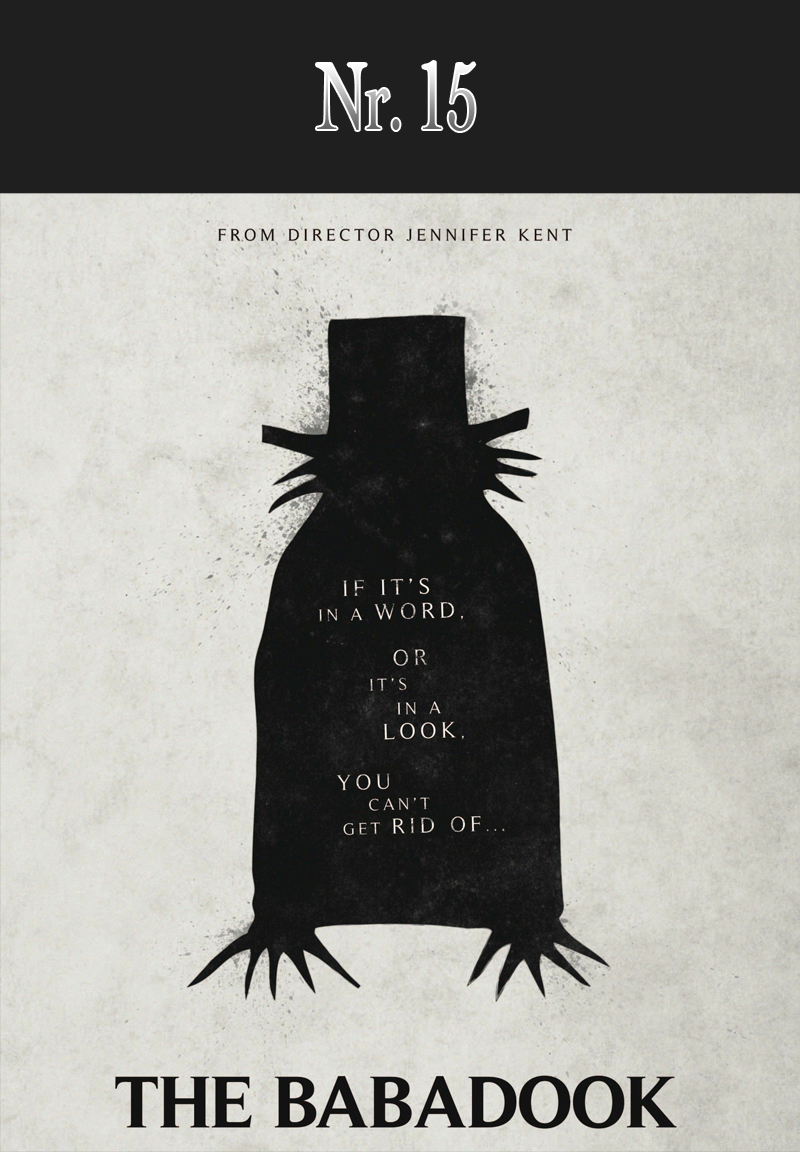
Many people in Australia will certainly be aware of The Babadook, because it’s an Australian production and it won “Best Film” at the AFI awards. However, it also shared the award with The Water Diviner, so I wouldn’t slap that on as a badge of honour.
Commercially the film only brought in a little over twice its $2 million budget, though. The Babadook made a subtle appearance at the cinemas before being purged in favour of Godzilla and Bad Neighbours. While I enjoyed Godzilla and detested Bad Neighbours, any credible film fan has to recognise the superior shelf life of this tiny Aussie picture. This is a film that horror lovers will compare future releases to and ask “why can’t we have more movies like that?”.
Still, I wouldn’t advertise it as a good horror, but actually as a good drama. There are few actual scary moments, and most of the film merely simmers in a creepy tone. Yet, as with all great horror, the gold lies in the story and not the shock tactics.
“A single mother, plagued by the violent death of her husband, battles with her son’s fear of a monster lurking in the house, but soon discovers a sinister presence all around her.”
– IMDB
At the heart of The Babadook lies the strange off-kilter relationship between the two central characters. Much like We Need To Talk About Kevin, it concerns a mother who struggles to love her son. He’s odd, violent, incoherent and obnoxious. At least, those are the superficial reasons for their broken relationship. As the plot develops, however, the real “Babadook” in the room begins to reveal itself. Thereafter, “if it’s in a word or it’s in a look, you can’t get rid of the Babadook”.
Clearly the best Australian film of the year, it’s the directing debut of Jennifer Kent, who I remember best as the Crime Scene photographer from Nine Network’s 1997 crime series Murder Call.

Kent’s 2005 short film Monster served as the springboard from which she adapted this brilliant first feature, and I hope to see more of her work in the future. Australia, take note of this woman!
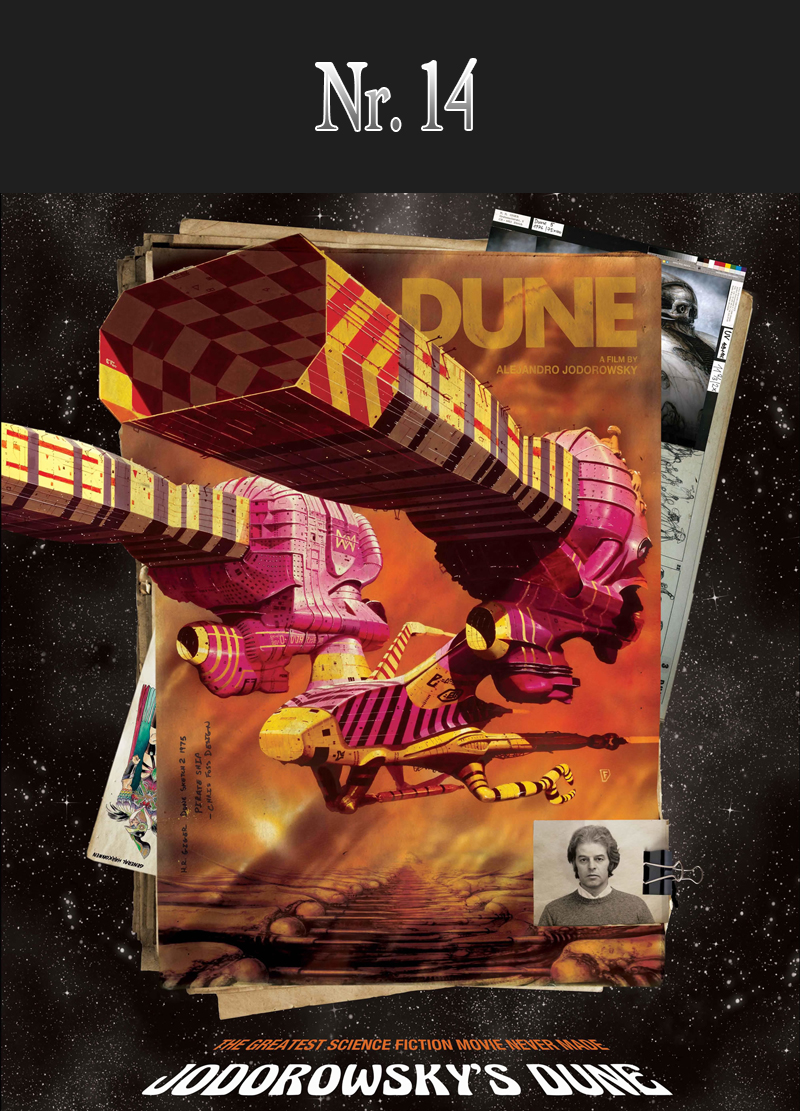
This one’s mainly for film buffs and makers, but I was absolutely enthralled by a totally neglected documentary named Jodorowsky’s Dune.
In case you were unaware, there is a very famous science fiction book series named Dune. There have been a couple adaptations since the original novels, in the form of a 1984 David Lynch film and two TV Miniseries named Dune and Children of Dune. None of them have been considered totally successful, and the 1984 attempt is a famously epic failure.
Why? Well, the world of Dune seems to be very hard to wrestle into a visual narrative medium. It’s the kind of twisted large-scale religious and philosophic empire that just doesn’t translate well to the screen. Perhaps a massive Game of Thrones-like TV show could do it, but…a film? Oi vey.
Over the decades several filmmakers have tried and failed, most of them never escaping the shackles of pre-production. Arthur P. Jacobs, Ridley Scott, and eventually David Lynch all had a bash. Lynch was the only one who ever put anything on screen, and then struggled to cut the film down from four hours to three. Eventually, after failing to secure artistic control, a hack-jobbed final product was spat out into cinemas that featured the singer Sting in a metal thong (no, I’m not kidding, check it out!).
In amidst all of this, there was an approach that many fans feel could have led to a proper depiction of Dune. It was the vision of Chilean filmmaker Alejandro Jodorowsky. Jodorowsky is, shall we say, an inspired man. If you’ve ever seen any of his films, you’ll know how bonkers he is…but perhaps bonkers is just what Dune needed.
Alejandro never made his version of the film, but spent years compiling a production bible that contained every concept, storyboard, musical piece, and casting decision that he would ever need if he could just secure financial backing for the movie. This is the subject of Jodorowsky’s Dune, and it’s marvellous to see how the evolution of this unrealised project inspired so many others, like Alien, Blade Runner, Contact, Star Wars, and Gravity.

I’ve heard people describe Calvary as a comedy. Well, apparently I don’t understand Irish comedy, because I didn’t find it very funny. That doesn’t mean that I didn’t like it, I’m just not a fan of false advertising.
“After he is threatened during a confession, a good-natured priest must battle the dark forces closing in around him.”
– IMDB
To fully appreciate Calvary, you need to understand what it is; a throwback to old fashioned crime noir stories. Set up like a classic Hardboiled picture, the film merely substitutes a catholic priest for the traditional cynical alcoholic detective. In keeping with this structure, the protagonist is set off on a private “whodunnit” investigation, and along the way meets a bizarre cast of sinful characters that make up the corrupt backbone of his little Irish seaside town.
Don’t expect laughs, expect scowl and brooding menace as Father James wades in the murky pools of hatred, temptation, and revenge. A deliberately slow burn, this is not a movie you’ll be re-watching anytime soon, but you just might find it intriguing upon a single viewing.

I am not a Jim Jarmusch fan. I don’t know what he smokes, but I don’t want any of it. Film sin number one is to make something boring, and number two is to make something pretentious. Jarmusch typically achieves both at the same time, which almost deserves a round of applause.
In 2014, however, he made…a good film.
Don’t get me wrong, Only Lovers Left Alive still meanders and drags in several places, certainly taking its sweet time to make its obscure point…but, all that being said, it’s actually good.
“A depressed musician reunites with his lover, though their romance – which has already endured several centuries – is disrupted by the arrival of uncontrollable younger sister.”
– IMDB
That description forgot to mention that the characters in question are actually vampires. There isn’t much of a plot to speak of, really. Only Lovers merely documents the day-to-day activities of living as a vampire. It brings vampirism into the real world and lets it play out in front of the camera. Tilda Swinton and Tom Hiddleston are perfectly believable as once-zestful sweethearts who’s souls have aged but their bodies haven’t. If you’re a Twilight fangirl, you’ll hate this movie, but if you’re an actual vampire film fan (the kind that can appreciate Near Dark, Thirst, Cronos, and Let The Right One In) then you’ll like it.

Frank is a film about the border between insanity and genius.
“Jon, a young wanna-be musician, discovers he’s bitten off more than he can chew when he joins an eccentric pop band led by the mysterious and enigmatic Frank.”
– IMDB
“Mysterious and enigmatic”? That’s what you call an experimental musician who always wears a giant paper-mache head? I call that utterly deranged, and yet…I find myself envious of the experience.
Frank is the sort of movie that will resonate more with some than with others, but everyone will find something to like about it.

If you’re a fan of 80’s synth musical scores and cheesy but fun John Carpenter aesthetics, then you have all the motivation you need to seek out The Guest.
“A soldier introduces himself to the Peterson family, claiming to be a friend of their son who died in action. After the young man is welcomed into their home, a series of accidental deaths seem to be connected to his presence.”
– IMDB
Ah yes, the ol’ “series of accidental deaths” that couldn’t possibly be related to this new stranger except for the fact that it totally is. This is not a movie with any surprises in it. There’s never any doubt about where we’re going, but it sure is a lot of fun getting there.
If you’re a fan of Downton Abbey, you’ll be familiar with Dan Stevens. For those of you who aren’t, though, just think of him as Cary Elwes’ younger clone.
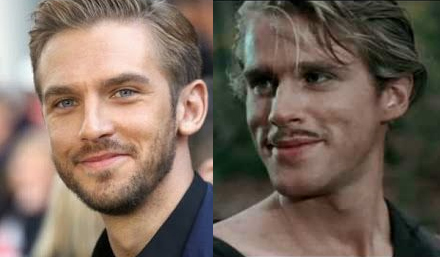
As if The Guest wasn’t transporting me back to 1987 already, suddenly this guy shows up and spreads that perfect Cary Elwes smile across his face. Wow! He even sounds like him! That alone is enough to make me like the film. There was hardly enough Elwes in the 80’s and 90’s, so give Dan Stevens some proper vehicles in which to grow his profile and let’s all relive those golden years!
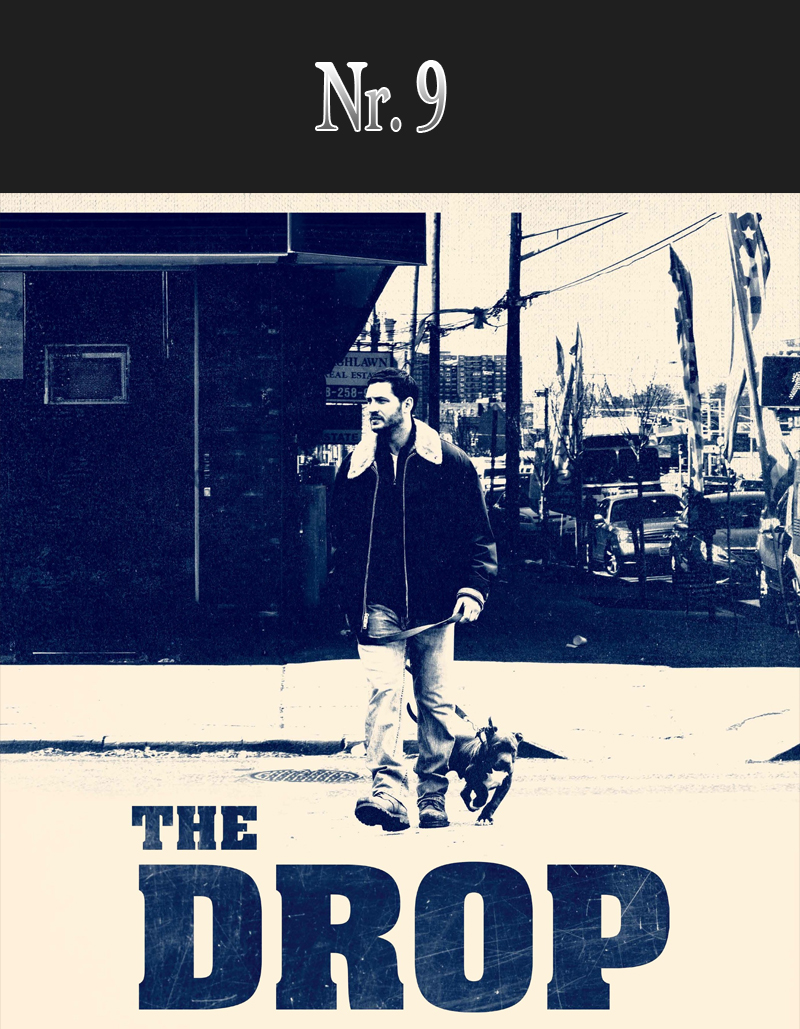
As Brad Pitt would ask, “do you like dags?”.
I should really be asking if you like puppies, and so there’s no need to ask because everyone loves puppies! If you like Tom Hardy, too, then there’s absolutely no way you can overlook this one.
“Bob Saginowski finds himself at the center of a robbery gone awry and entwined in an investigation that digs deep into the neighborhood’s past where friends, families, and foes all work together to make a living – no matter the cost.”
– IMDB
There are a few different plot strands going on here that slowly but surely merge. All of them orbit and close in on Tom Hardy’s character, who himself is a bit of an enigma. It also gets bonus points for being James Gandolfini’s final film. Go out and see it!

With gay marriage transitioning from illegal to legal, to accepted, and eventually boringly normal (although at different rates in different countries), now we’re beginning to see the movies that reflect that social change.
“After Ben and George get married, George is fired from his teaching post, forcing them to stay with friends separately while they sell their place and look for cheaper housing — a situation that weighs heavily on all involved.”
– IMDB
Love is Strange is far better than a typical schmaltzy gay-rights picture. There are no hateful yobbos yelling “faggot”, no bricks flying through windows, no lynchings, no slimy christian fundamentalist politicians blocking progress, and no loveable conscientious objectors crowbarred into the story to make modern liberals feel proud of their own political stance. Instead, it takes the marital relationship of the two central characters for granted and then tells its story from that point on.
The best part is that you can feel the love between them. While the story may be (at times) uneventful, the chemistry between the main players is palatable and keeps you engaged. It’s far better than the Academy’s “yay for gay” pick this year, The Imitation Game, because it isn’t interested in preaching to the choir or caricaturing the dissenters.

Anyone with an aversion to coarse sexual language should skip this one. If you do, however, you’ll be missing out on a very moving film. This is usually what happens to prudes. They can’t see beyond the surface of things, and subsequently miss a lot of great and valuable content. Take your narrow mind out of your tight ass and give this one a go, it’s lovely! What’s it about?
“A twenty-something comedienne’s unplanned pregnancy forces her to confront the realities of independent womanhood for the first time.”
– IMDB
No, no, no, stop! Come back. It’s ok, it’s not that kind of film. Just like Love is Strange didn’t waste time speechifying about gay rights, this movie makes no bones about its stance on unplanned pregnancy. It knows exactly where it’s going…in the bin!
Ok, that’s a harsh way to put it, but when Donna discovers that she’s pregnant she never hesitates about her decision to have an abortion. The real dilemma centres around how to best inform the stranger that she slept with. It’s also really cute and very funny. I dare say that even a “Pro-Lifer” could find a lot to love about this movie.

Back in 2010 we were given The Trip, a cheeky fly-on-the-wall look at the seething clash between two “straight-man and funny-man”comedians who agreed (through gritted teeth) to travel across the English countryside together in search of the most exquisite gourmet food available. If you missed it, I suggest you find it immediately and enjoy all the snappy one-liners and uncanny impressions that Steve Coogan and Rob Brydon had to offer as they sat squarely on each others nerves the entire time.
Now we have The Trip to Italy, and this time the tables have turned. Well, perhaps not turned, but they’ve at least shifted a little. Steve and Rob are back, playing exaggerated versions of themselves, but having detectably more fun this time around.
Like the original, The Trip to Italy exists as a six part BBC miniseries that was later squashed into a 2 hour movie and released in theatres. If you like the film version, the extended version is only more of the same goodness. So, you have that to look forward to. I was cackling through almost all of this. Impressively, the entire thing is improvised. You couldn’t forge wittier banter no matter how hard you tried.

Top five, ladies and gents, this is where it starts to get serious. These next five picks are not just the best of an invisible lot, they’re truly marvellous films.
You need to know what A Most Violent Year really is before you actually see it, otherwise you may be disappointed. People hear “violent” in the title, and they think they’re in for a bright red pulpy Scorcese picture. This is not Taxi Driver or Goodfellas, but its definitely in the same league in terms of quality.
“In New York City 1981, an ambitious immigrant fights to protect his business and family during the most dangerous year in the city’s history.”
– IMDB
The brilliant and increasingly successful Oscar Isaac plays Abel, a man stretched thin between opposing forces. On the one hand his wife and colleagues want him to retaliate violently against malicious competition, and on the other he is being investigated by the authorities who urge him to keep his business clean. More importantly, he is determined to be an upstanding businessman, faithful to the classic American Dream. So what will he do, mutate into a crooked gangster like everyone else or weather the storm with his head raised high? Moreover, who will suffer at the tail end of his prolonged indecision?
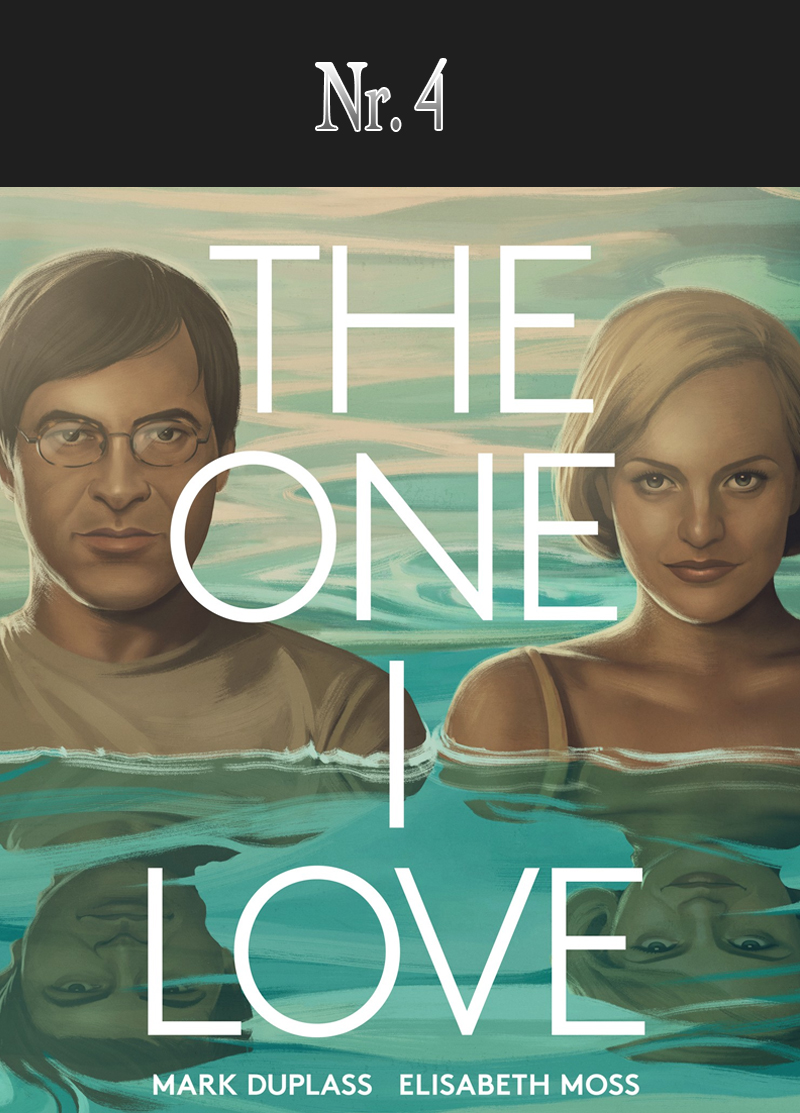
There’s very little I can say about this film, besides that it’s brilliant.
“Struggling with a marriage on the brink of falling apart, a couple escapes for a weekend in pursuit of their better selves, only to discover an unusual dilemma that awaits them.”
– IMDB
And I’d be spoiling a lot of the fun if I revealed to you what that “dilemma” was. Just know this; if you’re a fan of marital dramas and The Twilight Zone (because we know how often those two overlap) then this film is right up your isle.
Don’t google it! Enjoy the suspense and watch the movie.

I’m not bumping this one up on the list just because I have a twin sister. It’s just really, really, really good.
“Having both coincidentally cheated death on the same day, estranged twins reunite with the possibility of mending their relationship.”
– IMDB
The opening of this film makes it look like a first-world-problems movie, and I hate those. Very quickly, though, it becomes 100% relatable to anyone feeling lost and unfulfilled between the ages of 20 and 40. Maybe for those of you who have all your shit together with a stable loving family, secure finances, and great career won’t be able to identify with the main characters…but if that’s the case then fuck you anyways. Nobody should escape misery entirely, it’s not natural!
You may have your perfect life but the rest of us, the poor lost worried ones, will forever have The Skeleton Twins!
Also, it has one of the best renditions of “Nothing’s Gonna Stop Us Now” ever performed. If you don’t love this movie then I just can’t understand you.
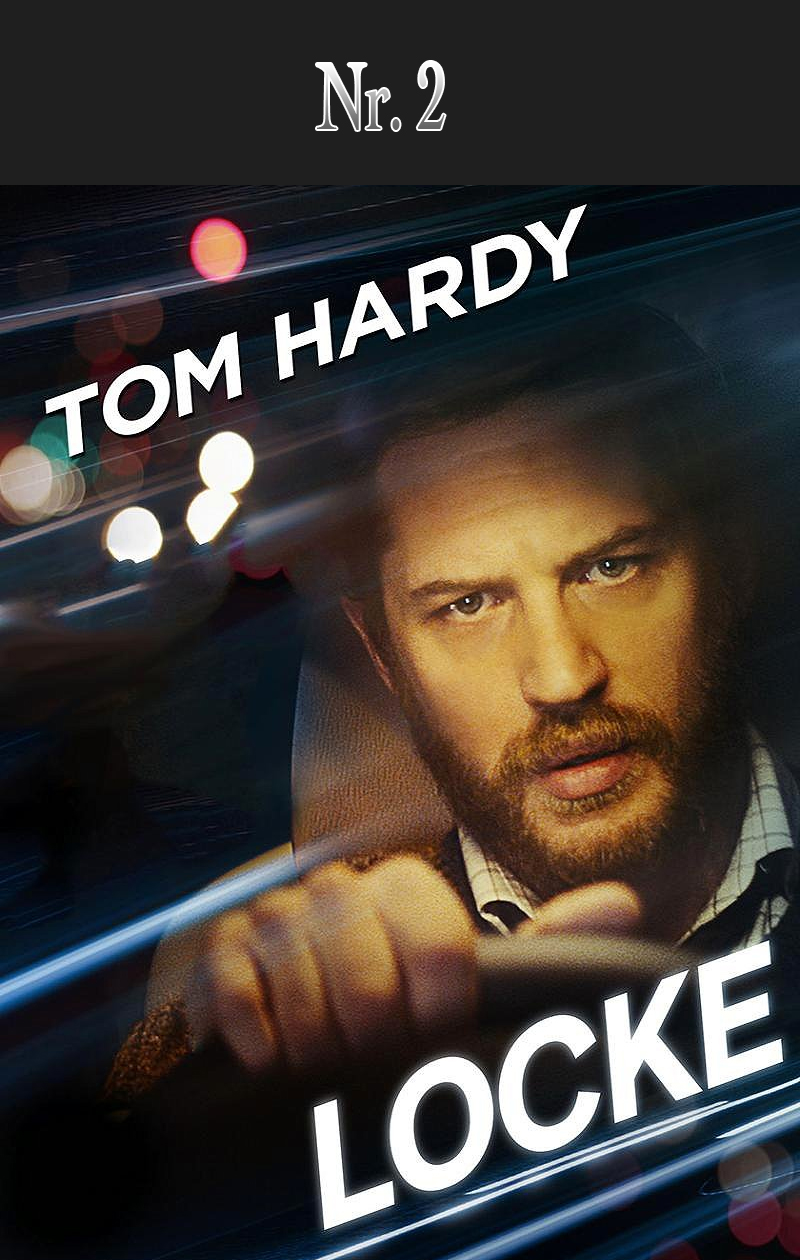
I’ve always been a fan of movies that do a lot with very little. A limited budget mixed with an interesting concept and a disciplined story often makes for a worthwhile film, if not an extraordinary one. I liked Buried a lot when it came out four years ago. Watching Ryan Reynolds trapped in a coffin for 90 minutes as his air supply slowly diminishes sounds like about as great a time at the cinemas as you could ever ask for.
This year Tom Hardy was in the drivers seat, literally, commandeering the tensely crafted British film Locke.
“Ivan Locke, a dedicated family man and successful construction manager, receives a phone call on the eve of the biggest challenge of his career that sets in motion a series of events that threaten his carefully cultivated existence.”
– IMDB
Stuck in his car for the full hour-and-a-half of screen time, Hardy’s world slowly closes in on him as he struggles to maintain order in his life.
Usually this kind of film resorts to some sort of hostage situation or terrorism plot, like 2002’s Phone Booth. Although I enjoyed the rising stress of Colin Farrell trapped in the sights of a high powered sniper rifle, I found myself wishing that one of these days a film would rise above that kind of cheaply generated conflict. Well, the gods seem to have answered my prayers.
Locke majestically manages to balance its central character on a tightrope without resorting to guns and knives. If he falls, there will be devastating consequences. I’m reluctant to go into more detail, suffice it to say that Tom Hardy shows even more of the chameleonic dedication that we’ve come to expect from him. From mixed martial arts boxer, to Bane, to a battered family man, Hardy is rapidly becoming the next Christian Bale (with a little more iron in his blood).

I could rave about this movie for days. From the second I saw the opening scene I knew it was going to be my favourite film of the year. Correction, it’s my favourite film of the last ten years. I’ve easily seen it fifteen times so far and it just keeps getting better. With that endorsement, here comes pompous Carl:
This is a movie for people who have a brain and like to use it. It requires you to engage with it as much as, if not more than, it engages with you. It’s not a movie that directly explains much, if anything, about its plot. Nearly every shred of storytelling is visual. You have to stitch together its sequential imagery to form your own comprehensive view of what’s going on and what it all means.
“A mysterious woman seduces lonely men in the evening hours in Scotland. Events lead her to begin a process of self-discovery.”
– IMDB
Anyone who has an interest in gender politics or sexual psychoanalysis should bask in what Under The Skin has to offer. Still, even without the pretentious intellectual crap, there’s a real heart and soul underneath all the “high art”. I can’t remember seeing a movie more lovingly and meticulously crafted, so it’s no surprise that the director, Jonathan Glazer, took a decade to make it.
Perhaps most strikingly, the sound design features an exquisite landscape of jarring electronic twitches, deep base tones, and eerie beckoning violin strings. Composer Mika Levi has crafted a score with what she refers to as a “pied piper tune” at its centre, which seduces your curiosity and yet leaves you unquestionably suspicious. This siren song sets the tone for what may just be one of the most creepy experiences I’ve ever had while watching a movie. I love it like an unforgotten ex-girlfriend. While I can’t stop revisiting it, it’s a deliberately unsettling experience that I’m doomed to repeat forever.
But hey, most of you will likely give up on this thing halfway through. Of those who do make it to the end, half will most likely regret the experience entirely and re-watch their Teenage Mutant Ninja Turtles DVD as an antidote to that god-awful intellectual stimulus they’ve just had to endure.
If you’re someone who loves true cinema, however, then I’ll be adding a longer post about my own interpretation of this movie as part of my next article on the director, Jonathan Glazer.
Under The Skin is a movie that needs to be seen! A hark back to classic 70’s science fiction horror and Kubrickian artistry, it’s easily the most interesting concoction of sight and sound you’re likely to come across for quite some time. Challenging, thoughtful, provocative, and gorgeously shot. If you can only pick one movie from this list, it should be this one, but they’re all great in their own way.
Tough Race 2: Electric Boogaloo

Congratulations to Birdman, it really is the most deserving film in the Best Picture category. I thoroughly enjoyed it, and was glad to see the Oscars (for once) rise above the pressure of historians and human rights activists.
Still…I hate being wrong.
It’s rather shocking to me that Boyhood, the clear frontrunner mere months ago, only picked up one award for Best Supporting Actress. It therefore joins The Imitation Game, American Sniper, and Interstellar in the category of “multi-nominated single-award winners”. Boyhood is far better than those three and it’s clearly a more innovative piece of filmmaking than any other entree this year, so what happened?
It turns out that even when the Oscars are unpredictable…they’re still predictable. Many astute observers pointed out that Birdman winning big at the SAG (Screen Actors Guild) Awards cemented its victory at the “night of nights”. I naively hoped they were wrong, and painfully discovered they were right. That’s far from the only thing I messed up, though.
To start with, I accidentally doubled up on my nominations for Best Visual Effects, Best Original Screenplay, and Best Adapted Screenplay.
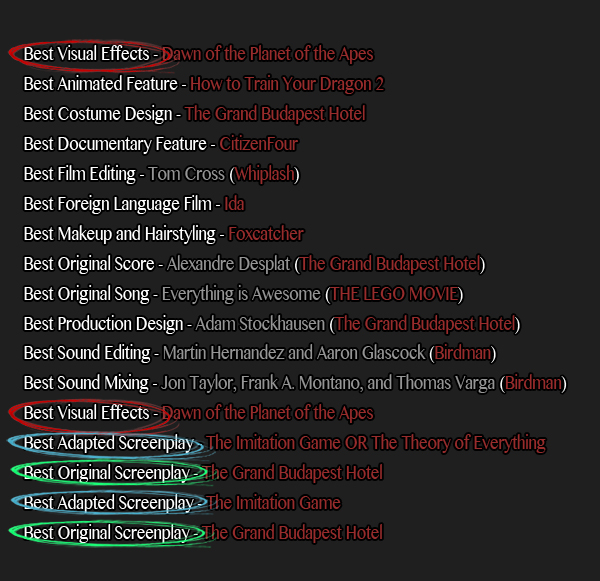

I typed up my predictions in Word and pasted them into Photoshop about 5 min before going to bed, so…fuck you! I was tired.
I’m more angry at myself for laying down so many incorrect guesses. Here’s how my predictions ended up:
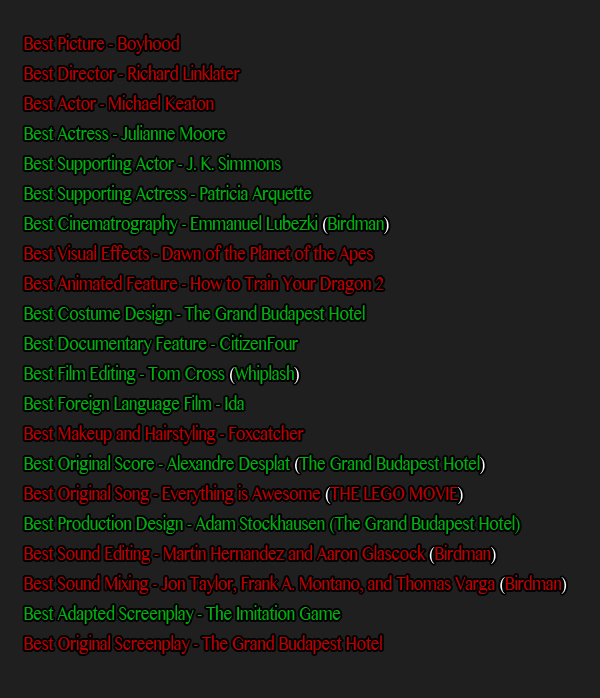
11 Correct and 10 incorrect. Technically that’s a victory, but if I had bothered to take a stab at the “short film” categories it would all be over for me.
But hey, it’s not all about me. The 87th Academy awards ended up being intensely political. First there were awkward but solid Neil Patrick Harris jokes like calling the Oscar nominees “Hollywood’s best and whitest” and explaining that Edward Snowden was absent “for some treason“. Then it became clear that The Academy got the memo about their racial discrimination, and decided to tip the scales back the other way by flooding the ceremony with black presenters, singers, and musical numbers. If you watched the event out of context, you’d think that Selma was well on its way to winning. Every few minutes someone was on screen sobbing about the power of the picture. Maybe, if it’s so important, you could have given it more than one “pity award” for Best Original Song.
Finally Patricia Arquette beat her chest on stage for female wage equality, clearly the most honest and worthwhile moment of the whole night (aside from J. K. Simmons’ plea for everyone to call their parents).
After a shitty year, the Oscars were better than I’d expected after all. Congratulation, again, to Birdman. You deserve it…especially you Keaton. As far as I’m concerned…you were robbed.
– Rant Over!
 Cinema Rant